


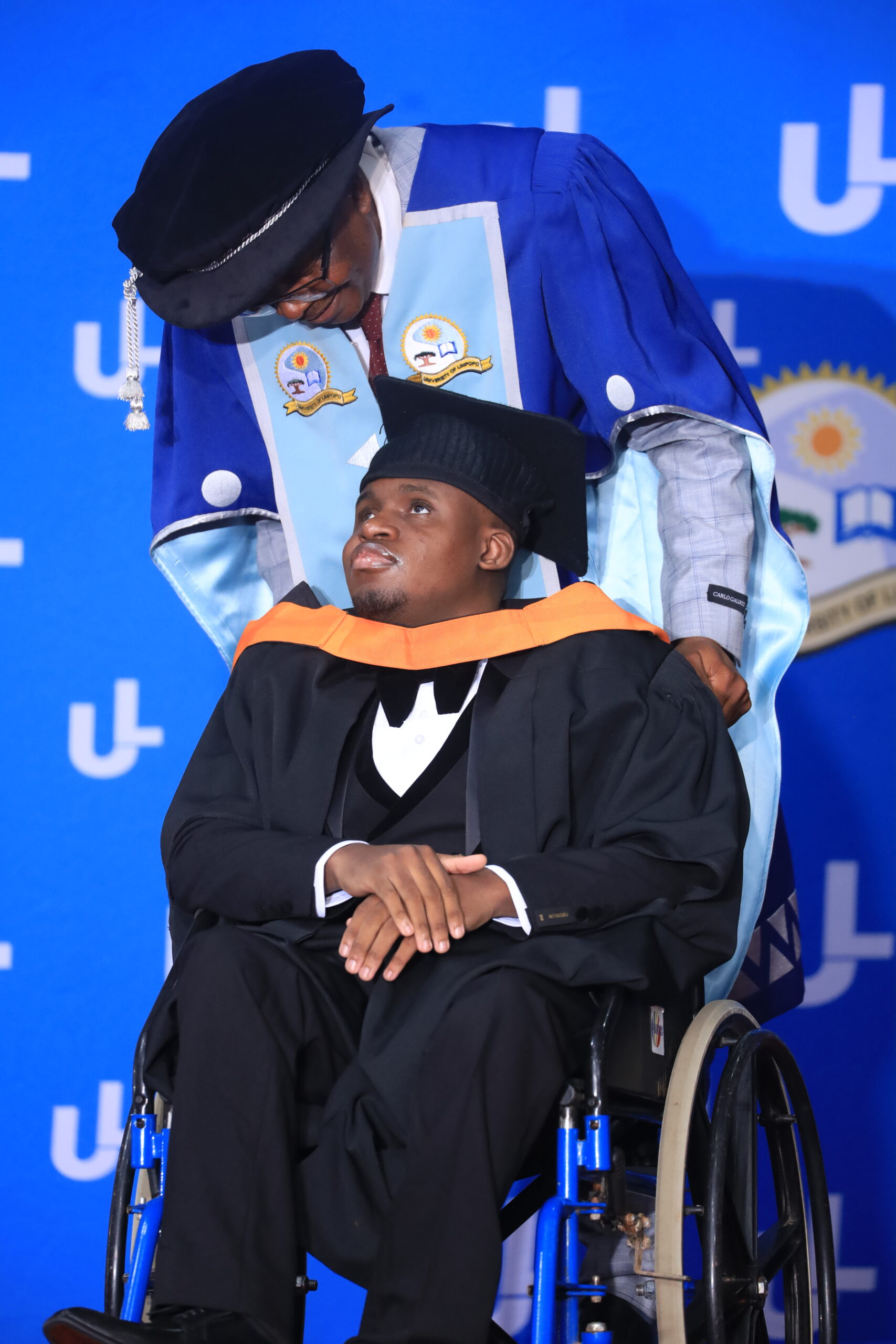
Thandolwethu Ngubeni proudly graduates with a Bachelor of Arts in Political Studies.
With courage, resilience, and the support of the University of Limpopo and family, Thandolwethu Ngubeni rises above physical and accessibility challenges to earn his degree
By Jostinah Mamabolo – ulpublications@ul.ac.za
Visually and physically impaired, Thandolwethu Ngubeni refused to let his circumstances define his future, graduating with a Bachelor of Arts in Political Studies from the University of Limpopo (UL)
His journey, however, was far from easy. His arrival at UL in 2022, after completing Grade 12 at Prinsh of School in Pretoria, a specialised institution for visually impaired learners, was met with the natural anxieties of navigating a new environment that demanded a high degree of independence and resilience.
“I was excited, but at the same time, I was scared,” he recalls. “I was transitioning into an entirely new environment that required me to develop a higher level of independence.” Although Ngubeni initially aspired to study Psychology, limited space led him to enrol in Political Studies, a decision that would ultimately shape his professional purpose in unexpected ways.
“Being blind and physically impaired did not define me — rather, it became a catalyst to prove my capabilities.”
Originally from Nelspruit, Mpumalanga, and raised in Midrand, Gauteng, Ngubeni grew up in a close-knit family of five. He credits his academic success to a strong family support system.
“Not everyone with a disability has the kind of support I have,” he says. “My family believed in my potential and sustained me during moments of self-doubt.” “I was born blind and physically disabled, but I can walk using crutches. My disability did not define me — rather, it became a catalyst to prove my capabilities.”
Beyond his family, the Reakgona Disability Centre (RDC) at UL served as a vital institutional support structure, creating an inclusive environment that enabled him to focus on his studies. “The university made things easier for me,” he explains. “The facilities were accessible, and the staff were always willing to assist. RDC became my safe space.”
One of his biggest challenges was adapting to technology. With limited computer skills at the outset, Ngubeni initially relied on braille for assessments — a process that was both slow and demanding. “I struggled a lot with computers at first,” he admits. “But I knew that if I wanted to succeed, I had to learn.”
With determination and institutional support, he gradually developed the technological competencies required. “It took time, patience, and practice, but I eventually became confident. That changed everything for me.”
Beyond his academic pursuits, Ngubeni’s daily life presented its own challenges. As a visually and physically impaired individual, he frequently encountered accessibility barriers and social biases, most notably situations where people addressed those around him instead of speaking to him directly. “Sometimes people assume you cannot speak for yourself,” he notes. “But I learned not to let those moments define me.” Instead, he chose to rise above these challenges with resilience and quiet strength.
While his field of study was initially a second choice, it soon became a passion. Through Political Studies, Ngubeni developed a deeper understanding of global issues, governance, and democracy — and found his voice. “It became far more than just a qualification,” he reflects. “It helped me understand the complexities of society and my place within it.” Whenever the journey became overwhelming, he leaned on his support system — family, friends, and his faith.
“There were difficult days, but I was never alone,” he says. “Encouragement from the people around me kept me going.” Now a graduate, Ngubeni reflects on his journey with a sense of accomplishment. “The path was demanding, but it was also rewarding,” he says. “Every obstacle served as a valuable learning opportunity.”