


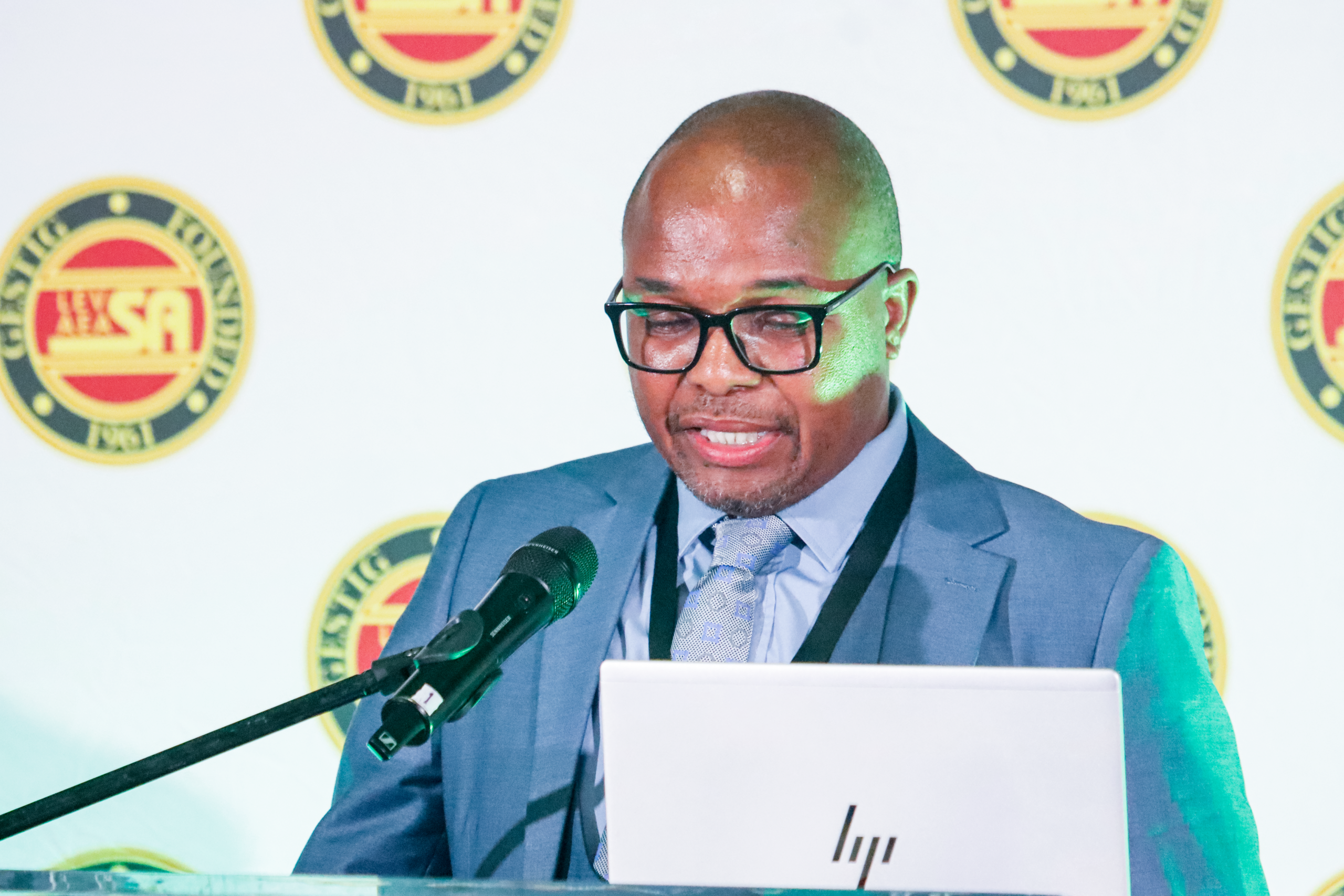
Professor Jan Hlongwane, President of the Agricultural Economics Association of South Africa (AEASA) and Professor of Agricultural Economics at the University of Limpopo (UL. Photos: Frans Nkhapele
Professor Jan Hlongwane urges agricultural economists to anticipate crises as UL researchers present studies on consumer trust, maize value chains and food security at the 63rd AEASA Conference
By Johannes Selepe | Mosela.selepe@ul.ac.za
Agricultural economists must anticipate crises such as climate change, foot-and-mouth disease and market disruptions rather than wait for them, Professor Jan Hlongwane told the 63rd Agricultural Economics Association of South Africa (AEASA) Conference held recently in Mokopane
Prof Hlongwane, AEASA President and Professor of Agricultural Economics at the University of Limpopo (UL), spoke at a conference UL co-hosted, where a UL doctoral student took first place in the poster category and UL researchers presented work on consumer trust, maize value chains and food security amongst others.
“We seem to be reactive. We wait for things to happen and react. We need agricultural economists who are going to be proactive,” he said.
Prof Hlongwane said AEASA had contributed to community development, land redistribution and climate change initiatives over the years. However, the sector needed to assess the impact of these efforts and identify ways to advance transformation in agriculture.
The conference, co-hosted by UL, the University of Venda and the Limpopo Department of Agriculture, brought together agricultural economists, policymakers and scholars to discuss challenges shaping agriculture and food systems.
Professor Leseilane Mampuru, Acting Executive Dean of UL’s Faculty of Science and Agriculture, said the conference was timely, given the economic, environmental, technological and geopolitical pressures facing agriculture.
This year’s theme, “Geopolitics in Agriculture: Striking a Balance Between Policy, Markets, Food Security and Shared Prosperity”, examined how international trade, changing markets, climate variability, technology and public policy influence food production and distribution.
Prof Mampuru said universities had a responsibility to ensure that their research and teaching benefited society, particularly rural communities and the agricultural sector.
UL researchers contributed to the discussions through studies addressing consumer trust, agricultural markets and transformation, amongst others.
Master’s student Valencia Mashegwana presented research on consumer trust in informal food markets among rural households in Makhuduthamaga Local Municipality, focusing on Ga-Mashegwana Village.
Her study, titled “Consumer Trust and Perceptions of Informal Food Markets: Evidence from Rural Households in Makhuduthamaga Local Municipality”, examines how product quality, household characteristics, market preferences and consumer experiences influence trust in informal markets.
Mashegwana, who is pursuing a Master of Agricultural Management in Agricultural Economics, was named Overall Best Student in the Faculty of Science and Agriculture and the School of Agriculture and Environmental Sciences in 2024.
UL doctoral student Lerato Malebati secured first place in the poster presentation category for her research on South Africa’s maize value chain.
Her paper, titled “A Systematic Review and Structural Design of the Maize Value Chain in South Africa: Market and Transformation Implications”, examined how maize moves through markets for human consumption and animal feed.
Using a systematic review guided by PRISMA 2020, the researchers screened 103 records and analysed 28 eligible studies.
The study developed a model mapping key players, product flows, processing stages and climate-smart practices. It identified nine value-chain pathways and highlighted coordination, market concentration, post-harvest losses and inclusion as areas requiring attention.
Through the conference and its research contributions, UL continues to contribute to discussions on food security, agricultural markets and the transformation of South Africa’s agricultural sector.
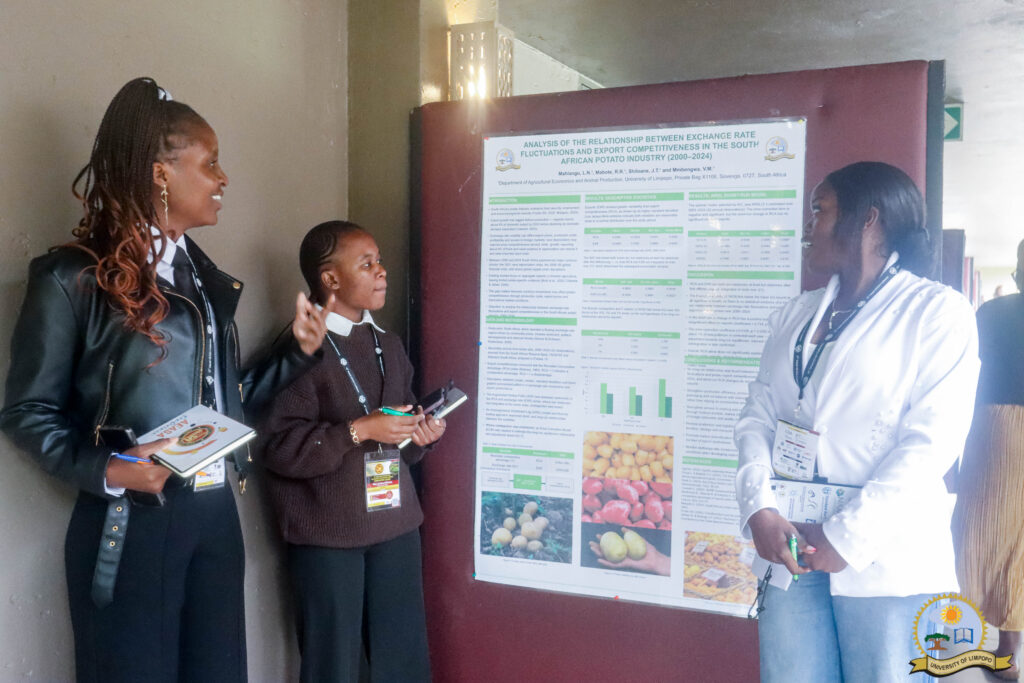
Researchers shared findings on consumer trust, agricultural markets, food security and transformation during the 63rd AEASA Conference.
“We seem to be reactive. We wait for things to happen and react. We need agricultural economists who are going to be proactive.”