


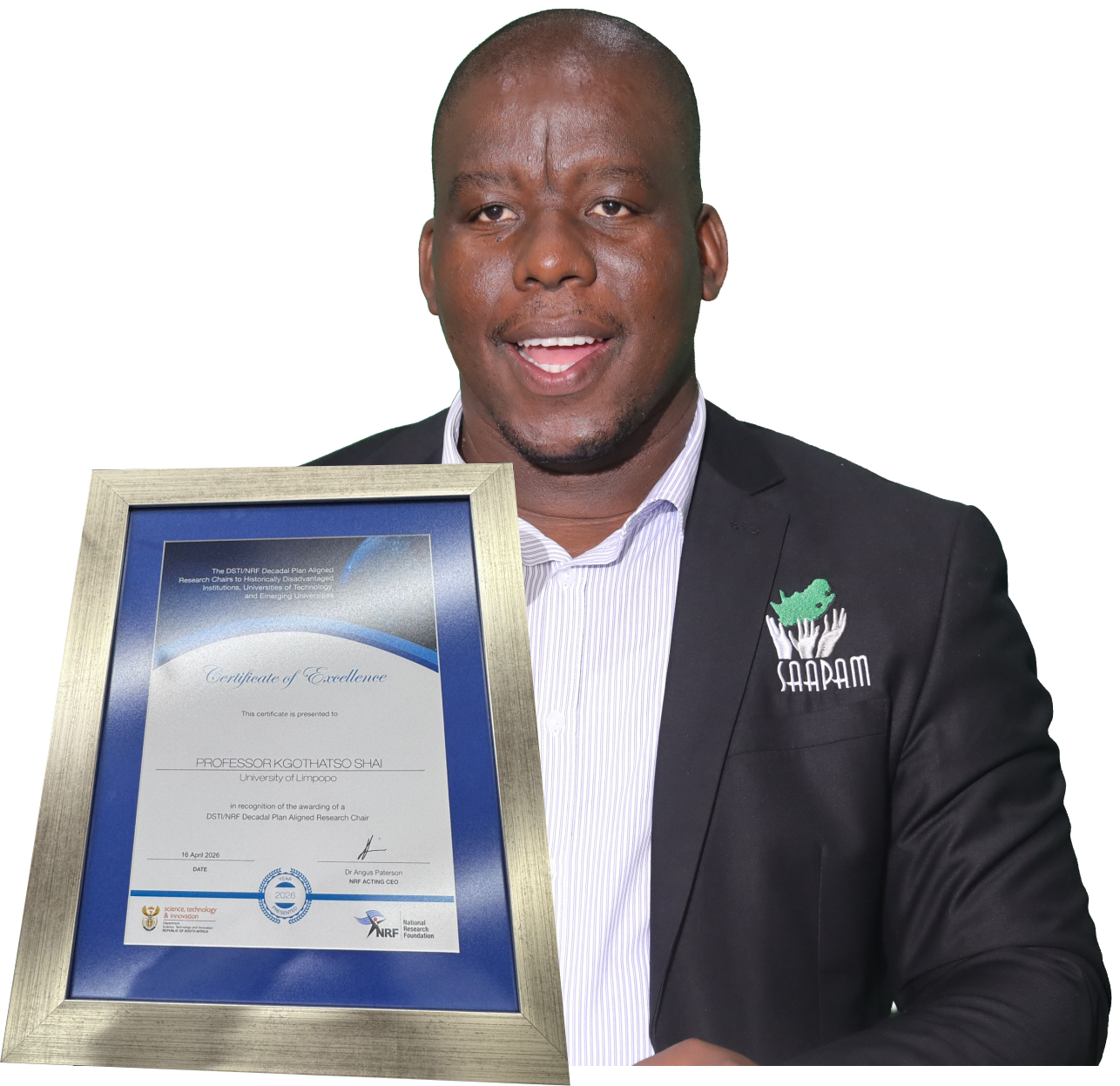
Professor Kgothatso Shai, holder of the NRF Tier 2 Research Chair in Liberation Heritage and Politics. Photo: Lebohang Mathaba
New NRF-funded Chair positions the University of Limpopo (UL) as a hub for decolonial scholarship, postgraduate training and community-driven research
By Johannes Selepe – Mosela.selepe@ul.ac.za
The story of African liberation is often viewed as a closed chapter, relegated to history books and commemorative events. However, the struggle continues to influence identity, citizenship and belonging in contemporary society.
To explore these dynamics, the University of Limpopo (UL) has established a Tier 2 Research Chair in Liberation Heritage and Politics, with support from the Department of Science, Technology and Innovation (DSTI) and the National Research Foundation (NRF).
Under the leadership of Professor Kgothatso Shai, a distinguished political scientist with a prolific record of over 100 publications and more than 40 postgraduate graduates, the Chair aims to serve as a dynamic platform for advancing research, empowering students and transforming communities.
According to Prof Shai, the appointment represents both a significant honour and a profound responsibility, requiring a deeper commitment to producing research that resonates with the lived realities of African societies.
“I feel challenged to pursue this work with renewed vigour, regardless of the obstacles,” he said. “This Chair demands work that goes beyond academic debates; it requires the generation of knowledge that is relevant, accessible and capable of shaping policy and public discourse.”
He added: “This Chair’s mission extends beyond research; it is about empowering students and communities to connect history with the present and shape Africa’s future.”
At its core, the Chair is designed to benefit students by fostering an intellectually diverse and interdisciplinary environment. By drawing talent from Political Science, History, Indigenous Knowledge Systems (IKS) and related fields, it will provide students with both theoretical depth and practical relevance.
Postgraduate students, in particular, are expected to benefit from intensive mentorship, acquiring skills that extend beyond traditional academia. They will be trained to bridge the gap between complex decolonial theory and practical policymaking, equipping them to contribute meaningfully to government, civil society and global discourse.
“Our ultimate objective is to produce graduates who are not only academically strong but also possess the strategic capacity to shape policy, influence high-level debate and articulate African perspectives on international platforms,” Prof Shai explained.
Beyond the academic setting, the Chair places communities at the centre of knowledge production.
Grounded in a decolonial and Afrocentric approach, the Chair challenges the notion of liberation as a static historical concept. Instead, it treats liberation heritage as a living body of knowledge, informed by both archival records and indigenous oral histories.
Using Limpopo as its primary research site, the initiative will explore the province’s rich yet often underrepresented history as a frontline of the liberation struggle. Through this work, it seeks to connect past resistance with present realities, generating insights that can inform policy, strengthen citizenship and promote social cohesion.
Prof Shai emphasised that communities will not merely be subjects of research, but active collaborators, contributing their lived experiences and knowledge to shape new narratives and solutions.
The Chair also represents a significant investment in UL’s research capacity and long-term impact.
With funding of R2 million per year in its first five-year cycle, renewable with increasing funding for up to 15 years based on performance, the initiative establishes a sustainable platform for high-impact research, postgraduate training and meaningful community engagement.
“This Chair’s mission extends beyond research; it is about empowering students and communities to connect history with the present and shape Africa’s future.”