


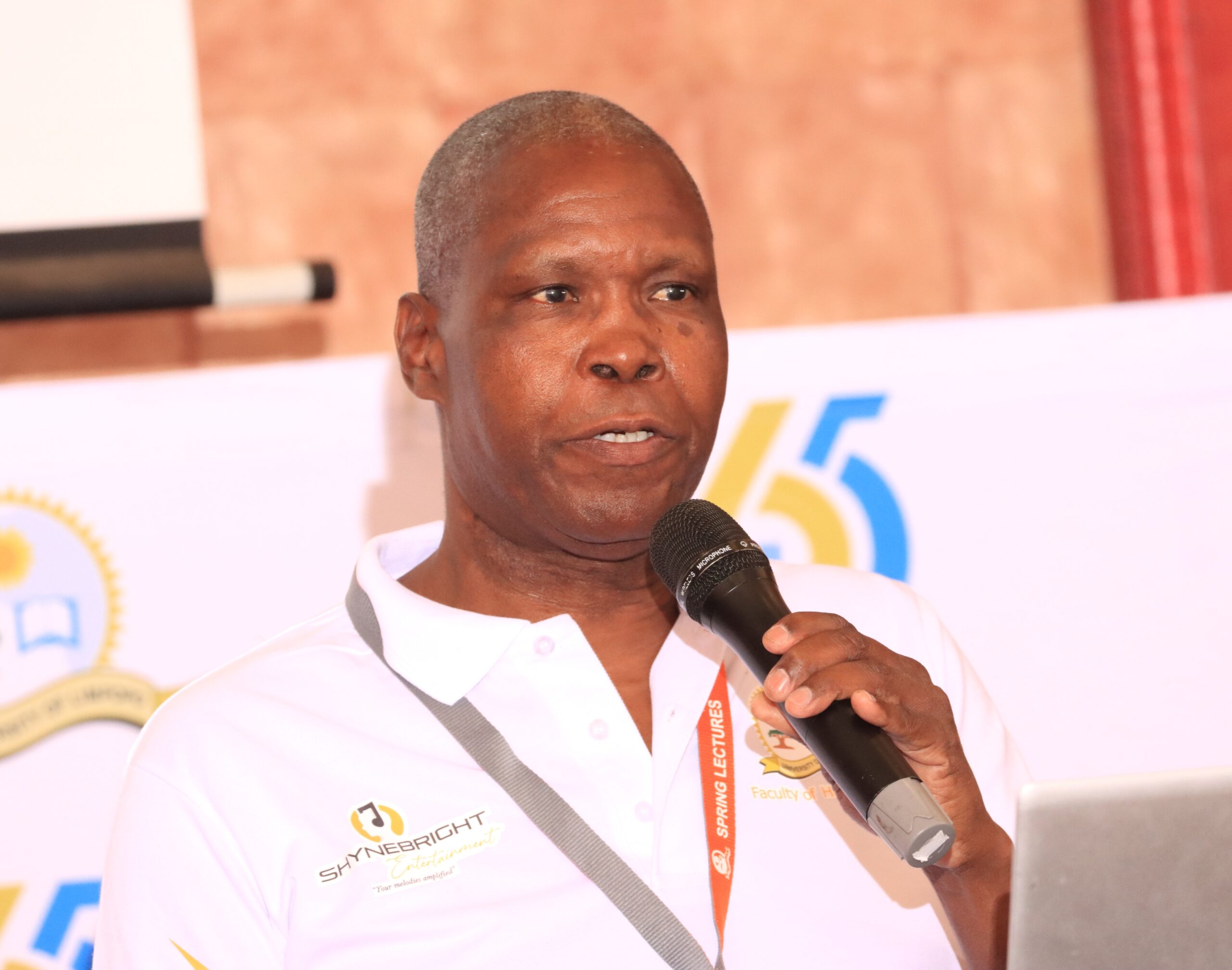
Prof Lesibana (JRL) Rafapa retires after seven years of service as Humanities Faculty Research Professor at the University of Limpopo. Photo: Malatji Monyelegwete
Retiring academic leaves behind a stronger research culture, a generation of mentored scholars and a faculty better equipped to meet the demands of knowledge production
By Malatji Monyelegwete- malatji.monyelegwete@ul.ac.za
When Prof Lesibana (JRL) Rafapa joined the University of Limpopo (UL) in 2019 as Humanities Faculty Research Professor, he returned to an institution that had once expelled him
Seven years later, he leaves not as a student activist shown the door by an apartheid-era administration, but as the academic who helped strengthen research in the university’s largest faculty.
Prof Rafapa will retire on 30 June 2026 after leading research development in the Faculty of Humanities, a sprawling academic division comprising 12 departments and three schools. His tenure coincided with increasing pressure on South African universities to improve research output, attract postgraduate students and maintain rigorous quality standards.
Within that environment, he became a central figure in supporting academics and postgraduate researchers, often working behind the scenes to ensure that research projects, publications and institutional submissions met increasingly demanding requirements.
The role came with its share of obstacles. The size of the faculty, coupled with limited staffing in the Research Professor’s office, meant that deadlines and quality assurance processes often had to be managed with constrained resources. Colleagues describe him as a steady presence who focused on building systems that would outlast his tenure.
His contribution extended beyond administrative oversight. Prof Rafapa devoted considerable attention to mentoring emerging academics, encouraging staff members to publish their work and guiding postgraduate students through the complexities of academic research.
For him, research has always been linked to society rather than existing solely within university walls.
“Research plays a critical role in addressing socio-economic challenges through the generation of knowledge, innovation and practical solutions that contribute to sustainable development and improved quality of life,” he said.
That conviction has shaped much of his academic career.
His return to Turfloop carried deep personal significance. As a Student Representative Council leader during the politically turbulent early 1980s, he was expelled alongside fellow student leaders for their involvement in anti-apartheid activism.
“My indulgence during my tenure at UL shifted to mostly servicing students from residential areas in the ambience of my alma mater,” he reflected.
Returning to the institution decades later represented both a professional achievement and a form of closure. Yet he says the greatest reward was the opportunity to work with young scholars.
As retirement approaches, he identifies mentoring postgraduate students and early-career academics as the aspect of university life he will miss most.
Prof Rafapa’s academic journey began at Mmadikana High School in Mokopane, where he obtained a matric exemption pass in 1979. After completing a BA Honours degree in English and a University Education Diploma at the then University of the North now UL, he went on to earn a Master’s degree in General Linguistics and later a doctorate in English from Stellenbosch University.
His career included lecturing at Mokopane College of Education, serving as a director at the Pan South African Language Board (PanSALB), and holding senior academic positions at the University of Venda and the University of South Africa, where he became Chair of the Department of English Studies.
Throughout that journey, he drew inspiration from academic leaders such as the late Prof Potinus Carl Matsiri Mokgokong and former UL English Department Head Prof Charles Muller, whom he credits for demonstrating that leadership is rooted in integrity, competence and scholarly excellence.
As he prepares to leave office, Prof Rafapa’s legacy is likely to be measured not only through publications and research outputs, but through the academics and postgraduate researchers whose careers he helped shape. In a sector where research capacity remains one of higher education’s most valuable assets, that contribution may prove his most enduring achievement.
Prof Rafapa devoted considerable attention to mentoring emerging academics, encouraging staff members to publish their work and guiding postgraduate students through the complexities of academic research.