


The “lions of Turfloop” have officially reclaimed their voice when Jalapeu Films hosted a high-profile trailer reveal at Ster-Kinekor, Mall of Africa recently, for the feature film adaptation of Studying Under the Barrel of a Gun
The film will premiere at the University while simultaneously screening at Ster-Kinekor cinemas across Limpopo and Gauteng.
By Moses Moreroa – moses.moreroa@ul.ac.za
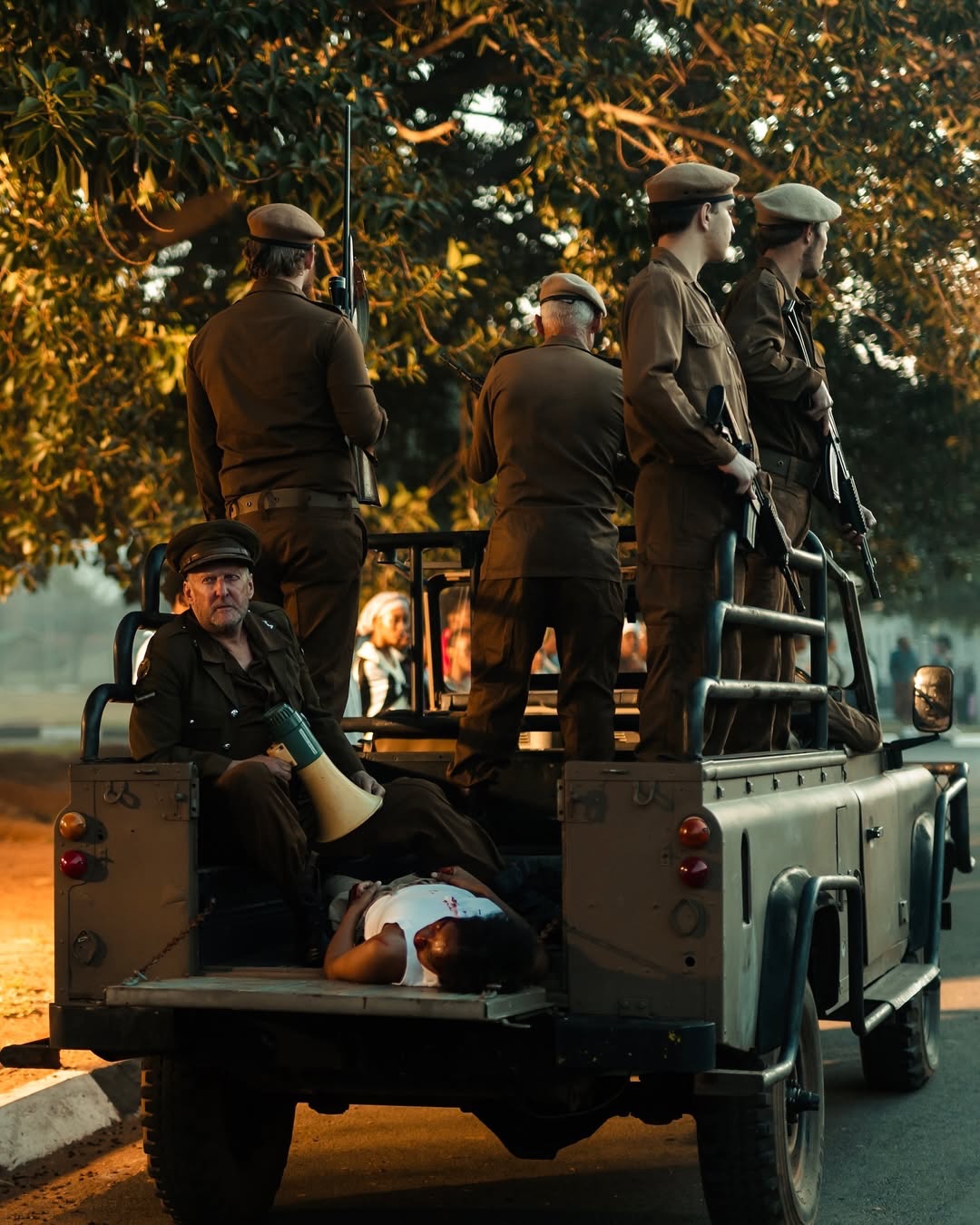
Literally Studying Under the Barrel of a Gun, a visceral reminder of the era when students were forced to pursue their education under the constant threat of state brutality. Photo: Scene from the film
The trailer for the gripping, action-filled feature film Studying Under the Barrel of a Gun was recently unveiled at Ster-Kinekor in Midrand ahead of its 12 June grand premiere at the University of Limpopo (UL), marking 40 years since the 1986 military occupation of Turfloop.
The narrative heartbeat of the film is the seminal memoir by Ernest Khosa, a two-term SRC leader (1988/89 and 1989/90), whose writing captures the unyielding spirit of a generation that refused to be ruled. The film was produced and directed by award-winning Tebogo Malope, who also served as Executive Producer alongside Cornet Thabiso Mamabolo.
In his opening address at the trailer reveal, UL Executive Director of Marketing and Communication, Victor Kgomoeswana, framed this artistic effort through the lens of resistance, noting: “If we do not write our own books and shoot our own films, we fall into the trap warned of by Chinua Achebe: ‘Until the lions have their own historians, the history of the hunt will always glorify the hunter.'”
Kgomoeswana said the film aimed to archive an institutional legacy that he believed was nearly lost to time. He underscored that the film was more than mere entertainment. “I stand here tonight not as a victim, but as a custodian of our memory,” he declared, grounding the project in a raw personal history. Kgomoeswana recounted making a deliberate “painful and necessary” stop at the Mokopane Police Station on his way to the reveal venue to revisit the walls where, in 1989, he was held in solitary confinement. As a young activist serving on the 1988/89 SRC, he was targeted by the apartheid security branch in a failed attempt to turn him into an informer. “They had, sadly, underestimated the steadfast character of this rural boy,” he remarked.
Kgomoeswana synthesised the story of the University of Limpopo through five transformative epochs, saying the institution began in the 1950s not through government decree, but through “the visionary traditional leaders who gathered under a tree in Mankweng on 11 October 1956”. He added that by the 1960s, while the “winds of change” swept across Africa, the apartheid government’s attempt to create a segregated “bush college” backfired. “The apartheid planners miscalculated; they built an intellectual greenhouse for revolution,” Kgomoeswana explained. He said the 1970s ushered in the fire of Black Consciousness, spearheaded by the inaugural conference of Steve Biko’s SASO and the iconic 1972 graduation speech by Abraham Onkgopotse Tiro.
The film’s title specifically references the 1980s, an era Kgomoeswana described as one of “unmitigated turbulence”. Following what he termed a chilling and “well-received” response from the Minister of Police to a student warning, the South African Defence Force (SADF) occupied the campus on 12 June 1986. “For three long years, our university was a military barracks,” Kgomoeswana recalled, adding that “we studied literally under the barrel of a gun”. He said the period was defined by the sacrifices of figures such as Peter Mokaba and Josephine Moshobane, noting that, finally, the 1990s marked a transition to triumph, punctuated by Nelson Mandela’s decision to serve as the Chancellor of only one university, the University of the North (now the University of Limpopo), symbolising its shift from a “site of war to a citadel of democratic leadership”.
Beyond the political struggle, Kgomoeswana highlighted UL’s status as “an academic phenomenon that defied every systemic odd”. He told the audience that the institution pioneered South Africa’s first university degree in optometry in 1975 and later became the first historically Black university to introduce the MBChB medical degree in 2016. “Today, with 25,000 active students and high-impact research chairs, the university stands as the economic heartbeat of Mankweng,” he added.
Kgomoeswana concluded by drawing on the imagery of Maya Angelou to describe the university’s journey: “Turfloop sang its revolutionary song even when caged by razor wire of apartheid state brutality. Today, that bird is free, and its song is captured on celluloid.”
The trailer reveal was attended by a distinguished assembly of UL alumni, including Rev Dr Frank Chikane, Irvin Phenyane, Judge George Phatudi, former Gauteng Premier David Makhura, and UL Convocation President Donald Selamolela, as well as Deputy Minister of Police Cassel Mathale.
The film, while unearthing raw talent, also stars seasoned actors such as Nthati Moshesh, Arthur Molepo, Molefi Monaisa, Nathaniel (Nat) Ramabulana, King Monada, Mashabela Galane, and Cornet Mamabolo.
The film will premiere at the University while simultaneously screening at Ster-Kinekor cinemas across Limpopo and Gauteng.