



Panellists discuss climate change governance and sustainable development during the University of Limpopo Global Leadership and Sustainability Symposium. Photos: Dimpho Boshomane and Lebogang Mathaba
Civil society, academics and business leaders examine the gap between climate commitments and action at the University of Limpopo
By Phishego Mohubedu -publications@ul.ac.za
The gap between climate commitments and action came under scrutiny as academics, government representatives, researchers and students gathered at the University of Limpopo (UL) for the second Global Leadership and Sustainability Symposium
Hosted by UL’s Turfloop Graduate School of Leadership (TGSL), the symposium was held under the theme “Innovation for Climate Change Governance and Sustainable Development”. The discussions focused on how leadership, research, governance and innovation can help address climate and development challenges.
The gathering brought together representatives from business and civil society, highlighting the need for cooperation beyond academic institutions in responding to climate change.
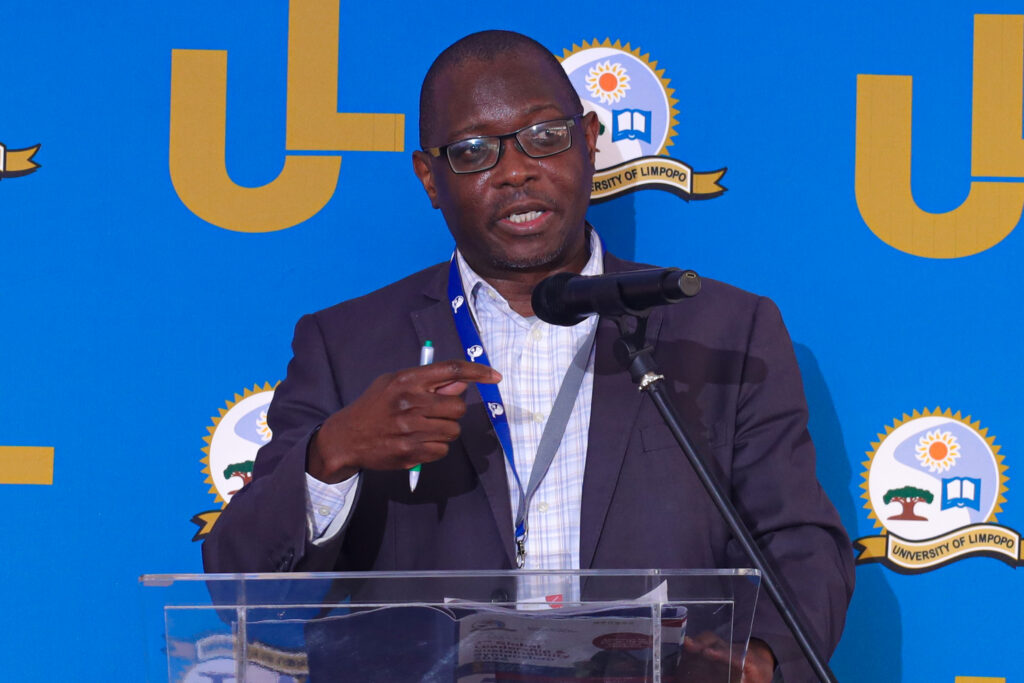
UL Vice-Chancellor and Principal, Dr Jeffrey Mabelebele, welcomes delegates to the second Global Leadership and Sustainability Symposium.
Welcoming delegates, UL Vice-Chancellor and Principal, Dr Jeffrey Mabelebele, described the symposium as an important platform for collaboration on climate change and sustainable development as the participants convened to take stock of what had been committed to, vis-a-vis, the actions on the ground.
“I encourage postgraduate students to engage with established researchers and urge stronger partnerships between the university and government to ensure that research addresses provincial and national priorities,” said Dr Mabelebele.
One of the keynote speakers, Acting Vice-Chancellor and Principal of the University of Venda, Prof Fulufhelo Netswera, placed leadership at the centre of the discussion, questioning whether technological advancement is always directed towards the public good.
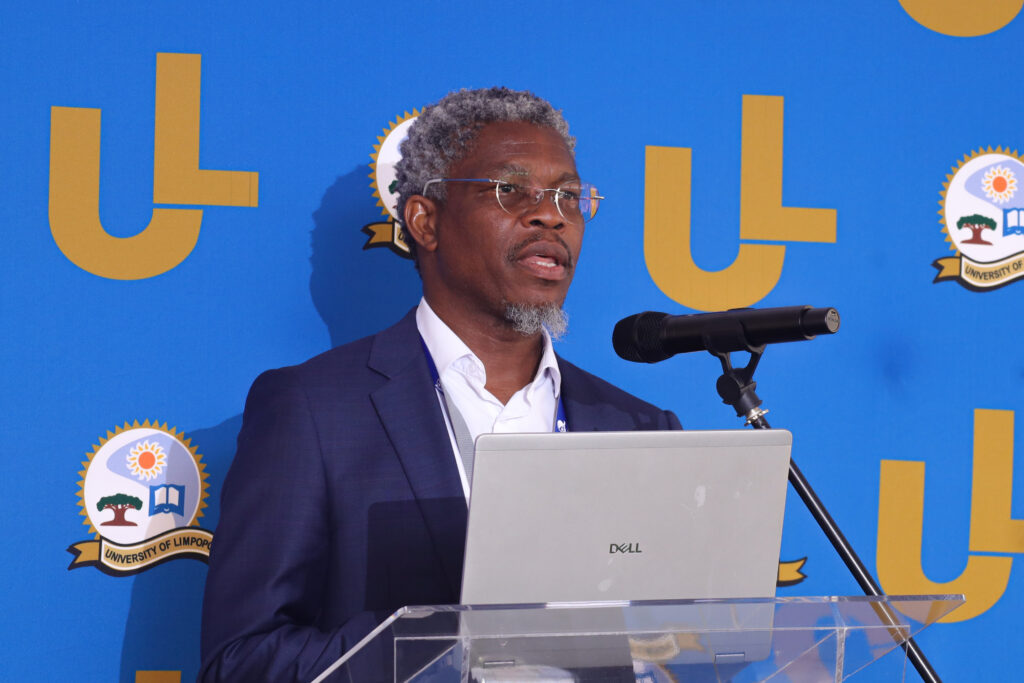
Acting Vice-Chancellor and Principal of the University of Venda, Prof Fulufhelo Netswera, highlights the importance of responsible leadership in directing innovation towards the public good.
Reflecting on artificial intelligence, climate change and persistent poverty, Prof Netswera said: “Our greatest challenge therefore may not be invention. It is whether we have the intention, the leadership and the political courage to direct innovation towards the public good.”
He cautioned against assuming that technology is automatically sustainable, pointing to the energy and water requirements associated with artificial intelligence and data centres.
Prof Thanyani Madzivhandila, Chairperson of TGSL Global Leadership and Sustainability, said the symposium was intended “to promote knowledge exchange and collaboration among stakeholders from different sectors.”
The question of how global challenges should be addressed at local level was also raised by Prof Ricky Mukonza, Deputy Chairperson of the Limpopo Research Forum, tying his commentary to that of UL’s VC and Principal. “Global leadership cannot be decoupled from local research and context,” stated Prof Mukonza.
Prof Mukonza added that Africa’s development requires knowledge systems that respond to local realities while engaging with global challenges.
He described UL as a “historical crucible of intellectual struggle and societal transformation” and called for research produced in Limpopo to translate into meaningful societal impact.
Prof Betty Mubangizi, an NRF Research Chair in Sustainable Rural Livelihoods at the University of KwaZulu-Natal, focused on the challenges of turning climate commitments into results.
Referring to South Africa’s Climate Change Act 22 of 2024, she said: “The distance between climate ambitions and commitments, and real-life outcomes is an institutional implementation gap.”
Prof Mubangizi identified fiscal limitations, fragmented mandates, weak coordination and structural inequalities as barriers to implementation, particularly in rural communities.
A major part of the symposium was the presentation of scientific papers by scholars from more than 19 universities in South Africa and abroad. The symposium also explored how different sectors can contribute to strengthening climate governance.
Pohotona Moyahabo from the University of South Africa examined taxation as a tool for climate governance in Limpopo’s mining sector. His presentation looked at environmental legislation, carbon taxation and accurate accounting as mechanisms for strengthening corporate environmental accountability.
Prof Matshidiso Kanjere, MBA Professor at TGSL, examined sustainable leadership and climate change mitigation in South African organisations, drawing on perspectives from Indalo Inclusive.
Her presentation highlighted the effects of floods, droughts and extreme weather on organisational operations and considered how leadership can support responses to these disruptions.
The discussions returned to a common question: how can research, leadership and governance move climate change from policy commitments to practical action?
For the delegates gathered, the answer lies partly in stronger institutions, locally relevant research and partnerships capable of connecting national and global priorities with the realities facing communities.