


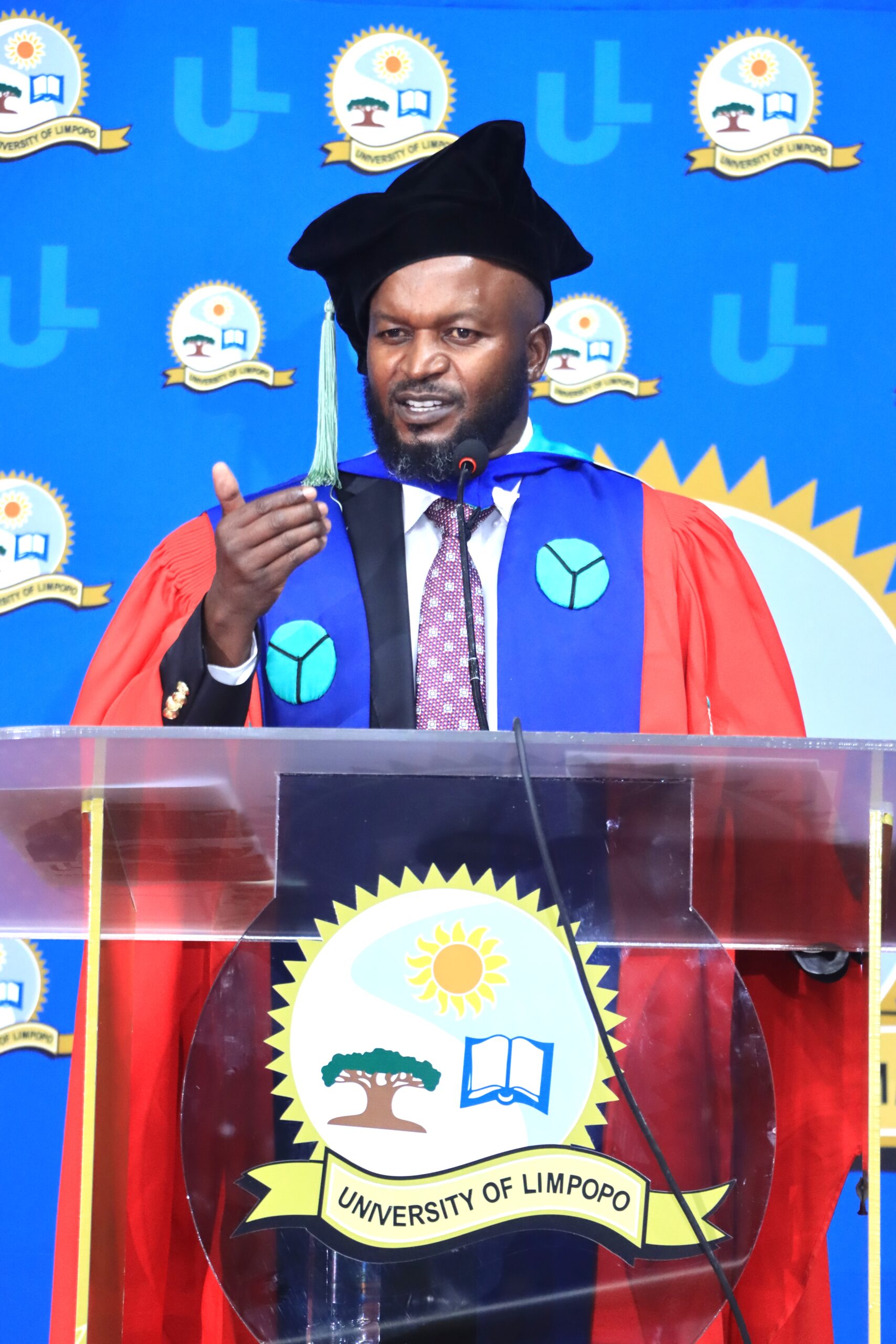
Dr Fred Mphephu, Managing Director of Ogeron, addressed graduates, highlighting the importance of sustainable development, water security and climate resilience in shaping South Africa’s future. Photos: Mohau Seleka
New climate change programme empowers professionals with practical, cross-sectoral skills to strengthen resilience across agriculture, mining, water management and infrastructure development
By Malatji Monyelegwete – malatji.monyelegwete@ul.ac.za
As the accelerating climate crisis increasingly disrupts communities worldwide through rising temperatures, prolonged droughts, catastrophic floods and food insecurity, the demand for actionable and sustainable solutions has never been more urgent
In response to these ecological challenges, the University of Limpopo (UL) is advancing climate education through its Climate Change Mitigation and Adaptation programme. Offered by the Faculty of Science and Agriculture through the Schools of Agricultural and Environmental Sciences, and Physical and Mineral Sciences, this intensive 12-week programme was launched in 2023 and recently celebrated the graduation of 36 participants in its second cohort.
The comprehensive curriculum provides participants with the scientific knowledge and practical skills necessary to mitigate the severe environmental and socio-economic impacts of climate change. By emphasising resilience, sustainability and innovation, the programme targets some of the most climate-vulnerable sectors, specifically agriculture, mining, water management and infrastructure development.
During the certification ceremony, Dr Fred Mphephu, Managing Director of Ogeron, underscored the need to integrate earth sciences, climate adaptation and sustainable infrastructure development to secure South Africa’s future.
He emphasised that water remains the ultimate catalyst for economic development, particularly within the agricultural sector, where irrigation and livestock production rely on dependable water resources. “Groundwater should be a key part of long-term sustainability planning, not just an emergency reserve,” he stated.
Turning his attention to industry, Dr Mphephu noted that while mining is vital to Limpopo’s provincial economy, the sector faces increasing climate-related risks. He challenged future mining professionals to intentionally blend technical expertise with environmental responsibility for sustainable industry growth. “Climate adaptation is no longer just an environmental buffer; it is essential for sustainable development and future economic stability,” he added.
Addressing agriculture’s extreme sensitivity to climate change, Dr Mphephu advocated for immediate climate-smart farming practices, including precision irrigation, drought-resistant crops and rainwater harvesting. He acknowledged the pivotal role of universities and research institutions in promoting climate science and sustainable solutions.
The Climate Change Mitigation and Adaptation programme boasts a comprehensive, multidisciplinary curriculum covering critical areas such as El Niño and La Niña patterns, carbon management, smart agriculture, climate law, precision farming, waste management, aquatic ecosystems, energy dynamics and the socio-economic impacts of climate change. Participants learn about climate science, mitigation strategies, adaptation measures and sector-specific vulnerabilities.
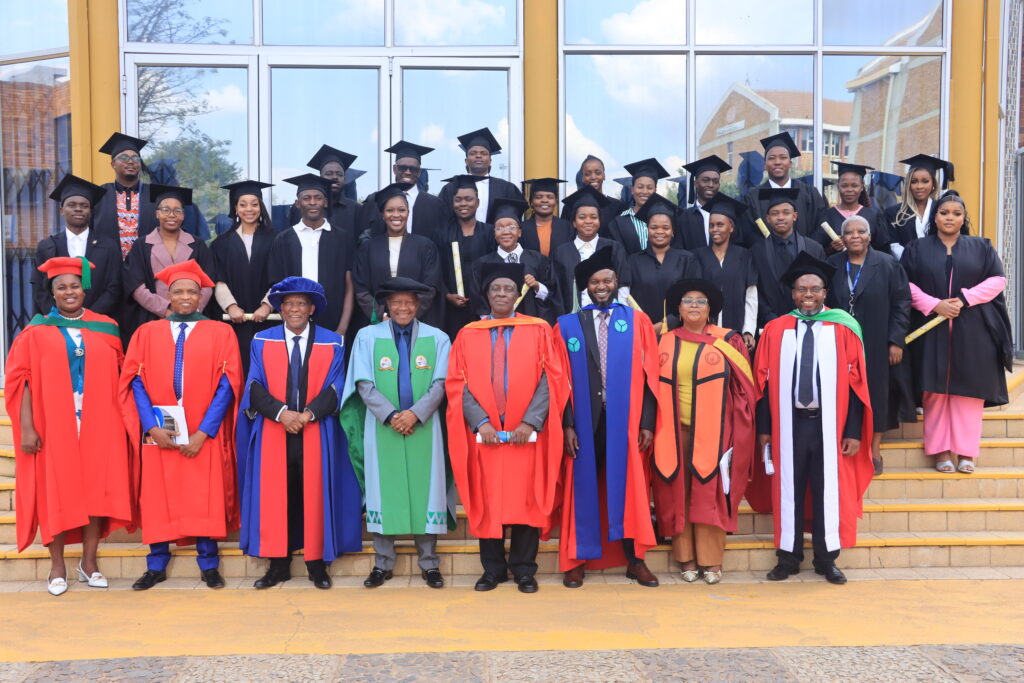
The 36 graduates of the Climate Change Mitigation and Adaptation Programme joined Heads of Departments and School Directors to celebrate the successful completion of the programme and reaffirm their commitment to addressing climate change challenges
To enrol, applicants must hold a four-year degree, Honours degree or Postgraduate Diploma at National Qualifications Framework Level 8 in any discipline. The course is open to qualifying UL staff and students seeking to diversify their skill sets.
Among the graduates was Cathrine Hlongwane, an NRF Postdoctoral Research Fellow at the Aquaculture Research Unit, whose research focuses on periphyton dynamics in aquatic ecosystems. She described the programme as challenging yet rewarding.
“The workload was exceptionally intense for a short course, and I considered stepping away, but I deeply valued the knowledge and was committed to finishing what I started,” she said.
Prof Pamela Mamogobo, an Associate Professor in the Department of Nursing Science, highlighted how the programme enhanced her professional and personal growth. “The experience reinforced my commitment to patient-centred care, a philosophy guiding my teaching and clinical practice for over 18 years,” she stated.
Abram Mothiba, an Assistant Librarian, noted that the programme significantly broadened his perspective and inspired him to pursue further academic opportunities. Senior Laboratory Technician Dolo Shila also expressed that the course would help her develop an integrated research project and sharpen her focus.
Reahoketswe Mabetwa, a Safety Officer in the mining sector, affirmed that the programme would enhance her career prospects in the industry.