


AMESA delegates exchanging ideas and insights to advance mathematics education. Photo: Frans Nkhapele
By Rinae Manenzhe – ulpublications@ul.ac.za
As part of its ongoing commitment to academic development, the University of Limpopo (UL) recently hosted the 30th Annual Congress of the Association for Mathematics Education of South Africa (AMESA)
The event drew educators, researchers, and students from across the country to share ideas and practices aimed at enhancing the teaching and learning of mathematics.
This marked UL’s first time hosting the congress since 2015, welcoming delegates from South Africa and beyond, all united in their mission to make mathematics education more inclusive, relevant, and engaging.
Mathematics transcends mere numbers; it is foundational to critical thinking, scientific progress, and innovation. However, for many learners, it remains a challenging and often exclusionary subject. The AMESA Congress addressed these concerns by providing a platform to explore how to make mathematics more accessible and impactful.
Parallel sessions covered a variety of topics, including foundation-phase teaching, mental maths strategies, and the integration of technology in the classrooms. The congress also celebrated AMESA’s 30-year legacy while identifying ongoing challenges and opportunities for growth.
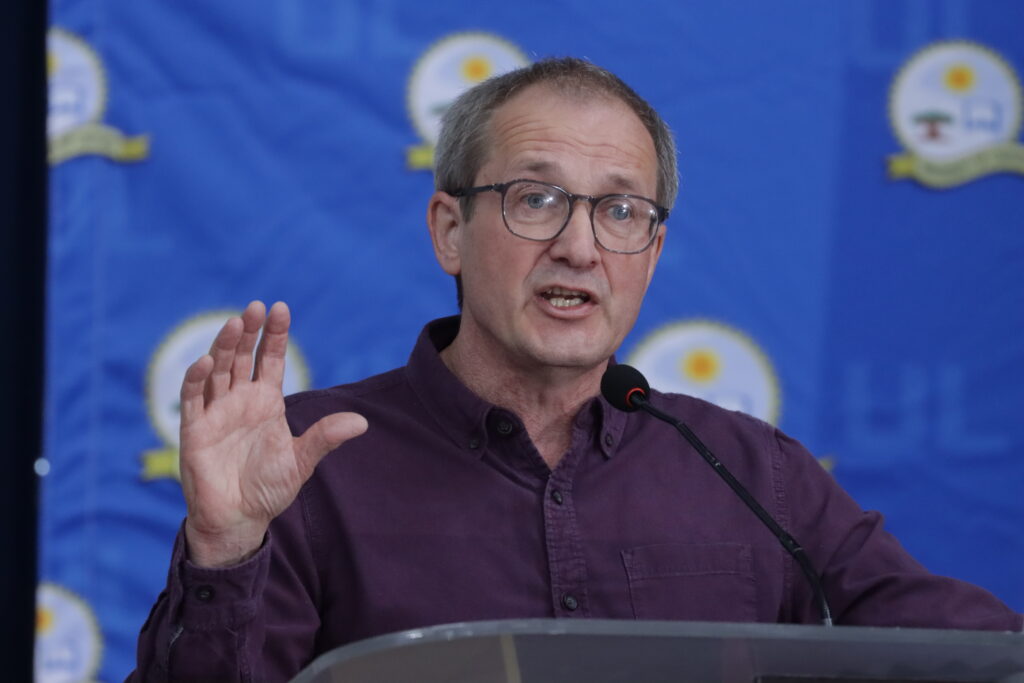
Dr Pete Wright from the University of Dundee in Scotland. Photo: Evidence Mongwe
In a keynote address, Dr Pete Wright from the University of Dundee, Scotland, emphasised the importance of equitable teaching. “Socially just maths teaching should involve progressive pedagogy, real-life applications, and empower learners to drive social change,” he stated.

Victor Kgomoeswana, UL’s Executive Director for Marketing and Communication, describes mathematics as a gateway subject.
Victor Kgomoeswana, UL’s Executive Director for Marketing and Communication, highlighted the far-reaching significance of mathematics. “Without a solid understanding of maths, many career paths remain closed. Let’s move beyond binary thinking; maths is the language of nature itself,” he asserted.
Prof Kwena Masha, UL Registrar, reflected on the university’s longstanding partnership with AMESA. “In 2006, our Department of Mathematics and Science Education was small. By 2015, it had grown significantly. Today, it’s one of our largest and most vibrant departments,” he noted.
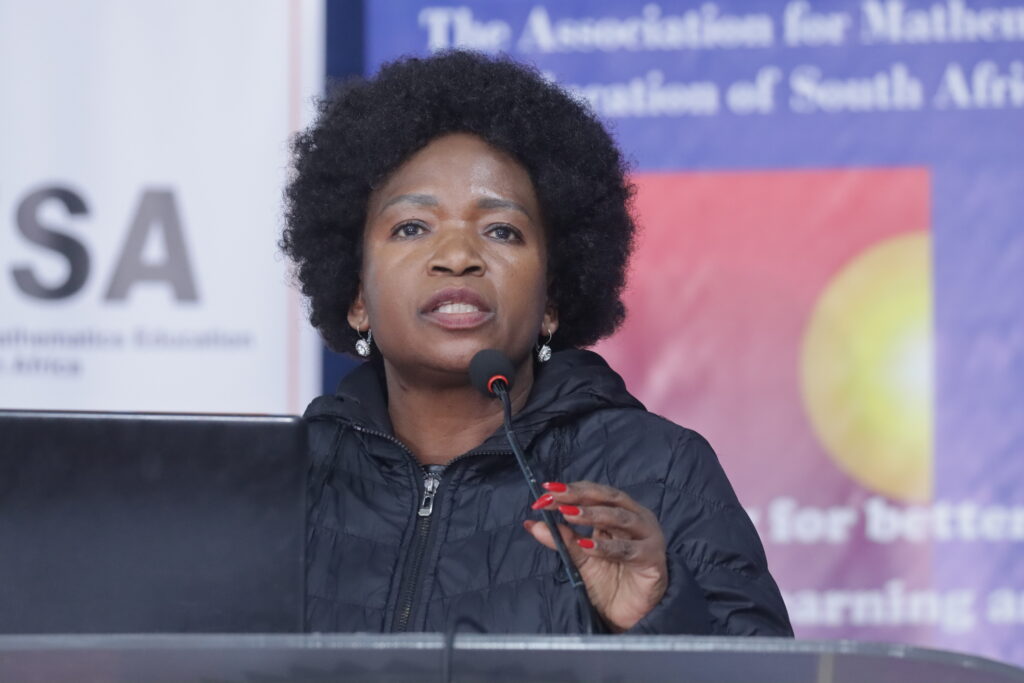
AMESA President Nkhensani Duba delivers a heartfelt message of appreciation to individuals who have played a pivotal role in the organisation’s growth and success. Photo: Frans Nkhapele
AMESA President, Nkhensani Duba, recognised long-serving members for their dedication to mathematics education. “Their commitment has transformed AMESA into the strong, respected organisation it is today,” she remarked.
For many attendees, the congress reignited their passion for teaching. Michael Thulare, a teacher from Mpumalanga, commented, “It’s not just about what we teach, but how. Our approach determines whether learners embrace or reject maths.” He commended the practical and engaging sessions.
Khwezi Jordan, a subject specialist from KwaZulu-Natal, described the congress as a valuable space for professional growth. She particularly appreciated a hands-on geometry workshop that employed playful techniques. “Learners won’t realise they’re learning, they will think they’re playing. That’s how we make abstract concepts concrete,” she explained.
The congress reaffirmed that effective maths teaching is not solely about delivering content but about inspiring confidence, nurturing potential, and making mathematics meaningful for all. Events like AMESA play a crucial role in reshaping classroom practice and ensuring that no learner is left behind in this essential subject.