


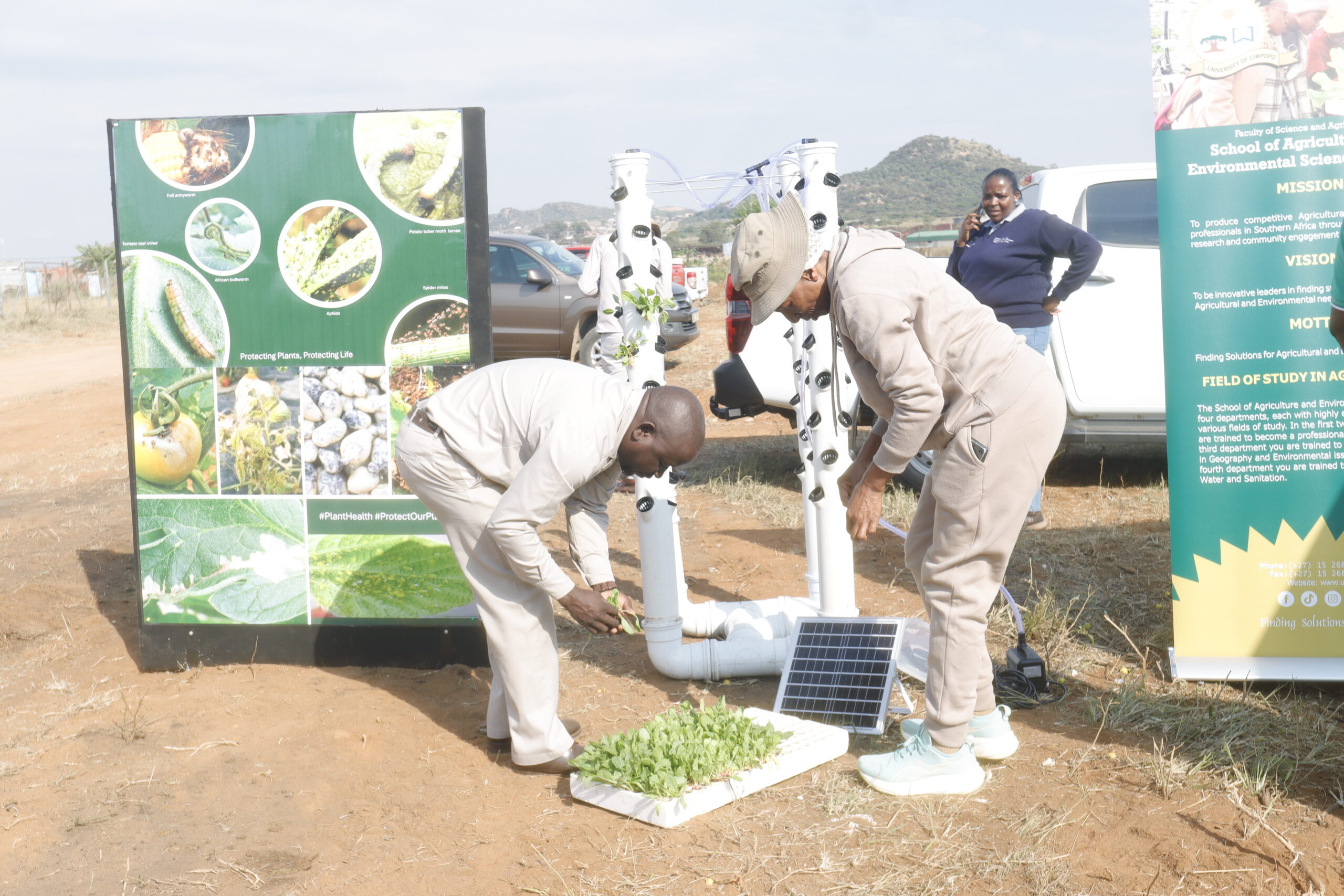
Aeroponic farming technology demonstrated to farmers during the International Day of Plant Health celebration. Photos: Frans Nkhapele
A plant health campaign in Mankweng connects farmers with agricultural experts to combat pests, diseases and poor soil management
By Rinae Manenzhe – ulpublications@ul.ac.za
The University of Limpopo (UL) is strengthening its support for local farmers by sharing practical strategies to protect crops, improve soil health and increase agricultural productivity
In collaboration with the Limpopo Department of Agriculture and Rural Development (LDARD), UL recently hosted a community workshop at the Ratanang Farmers’ Cooperative in Mankweng to celebrate the International Day of Plant Health.
Held under the theme “Plant Biosecurity for Food Security”, the event brought together farmers, academics, agricultural specialists and government officials. The aim was to discuss challenges affecting crop production and food security in local communities.
Ratanang Farmers’ Cooperative, known for its active farming operations and variety of crops, provided a practical setting for the engagement, which focused on helping farmers identify plant diseases, manage pests and adopt improved farming methods.
Prof Mapotso Kena, a plant pathologist at UL, said collaboration with farming communities allows the university to align its research with the challenges faced by farmers while sharing scientific knowledge that can improve productivity.
“The rich variety of crops cultivated here gives us a unique living laboratory. It is an opportunity to learn alongside farmers and gain insight into the different plant health issues affecting their yields,” said Prof Kena.
Farmers received guidance on common pests and diseases that affect crop yields, including fall armyworm, African bollworm and red spider mites.
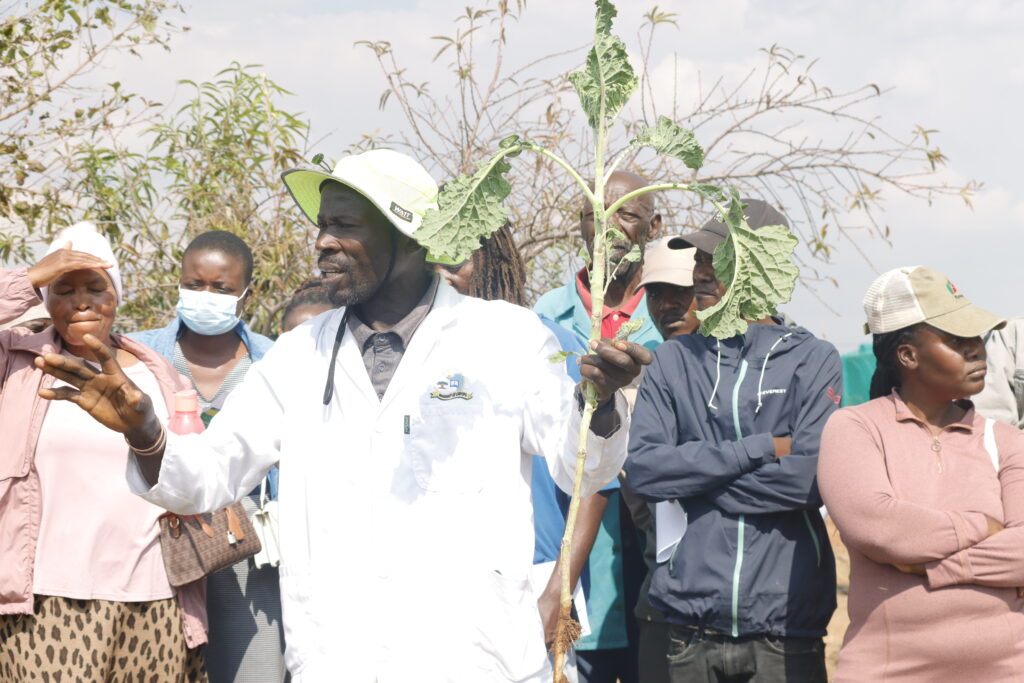
Edward Mathebula from the University of Limpopo engages farmers on sustainable farming practices and crop protection.
Edward Mathebula, a Senior Technician in the Department of Plant Production, Soil Science and Agricultural Engineering at UL, delivered a presentation on nematodes and the damage they cause to plant roots.
To reduce the impact of these pests, he encouraged farmers to avoid planting the same crops in the same area repeatedly and to practise crop rotation to improve soil quality and limit the spread of diseases.
“Do not plant the same crop in the same soil year after year. If you planted potatoes this season, choose a different crop for the next,” Mathebula advised.
William Mogano, Deputy Director of Capricorn South at LDARD, reminded attendees that healthy crops are essential for food production and sustainable farming.
“Plant health is crucial because healthy plants produce better quality crops and improved harvests,” Mogano said.

Mogano further explained that the department continues to support subsistence, smallholder and commercial farmers through the Agricultural Producer Support Policy, which provides fertilisers, irrigation systems, fencing, tunnels, seeds and other agricultural resources.
Local farmers welcomed the support and information shared during the event.
Linah Mashangwani, representing the host Ratanang Farmers’ Cooperative, said the information would help improve their farming practices and better protect their crops.
“We have gained valuable insights into plant health and learned important farming methods that we were previously unaware of,” she said.
Esther Modiba from Hidyahinkwaswo Primary Corporation in Ntsima Ga-Dikgale praised the partnership between the university and the department for addressing the challenges faced by farmers in the province.
“This collaboration is highly valuable because it does not just discuss our issues, but also provides solutions to many of the farming challenges we encounter,” said Modiba