


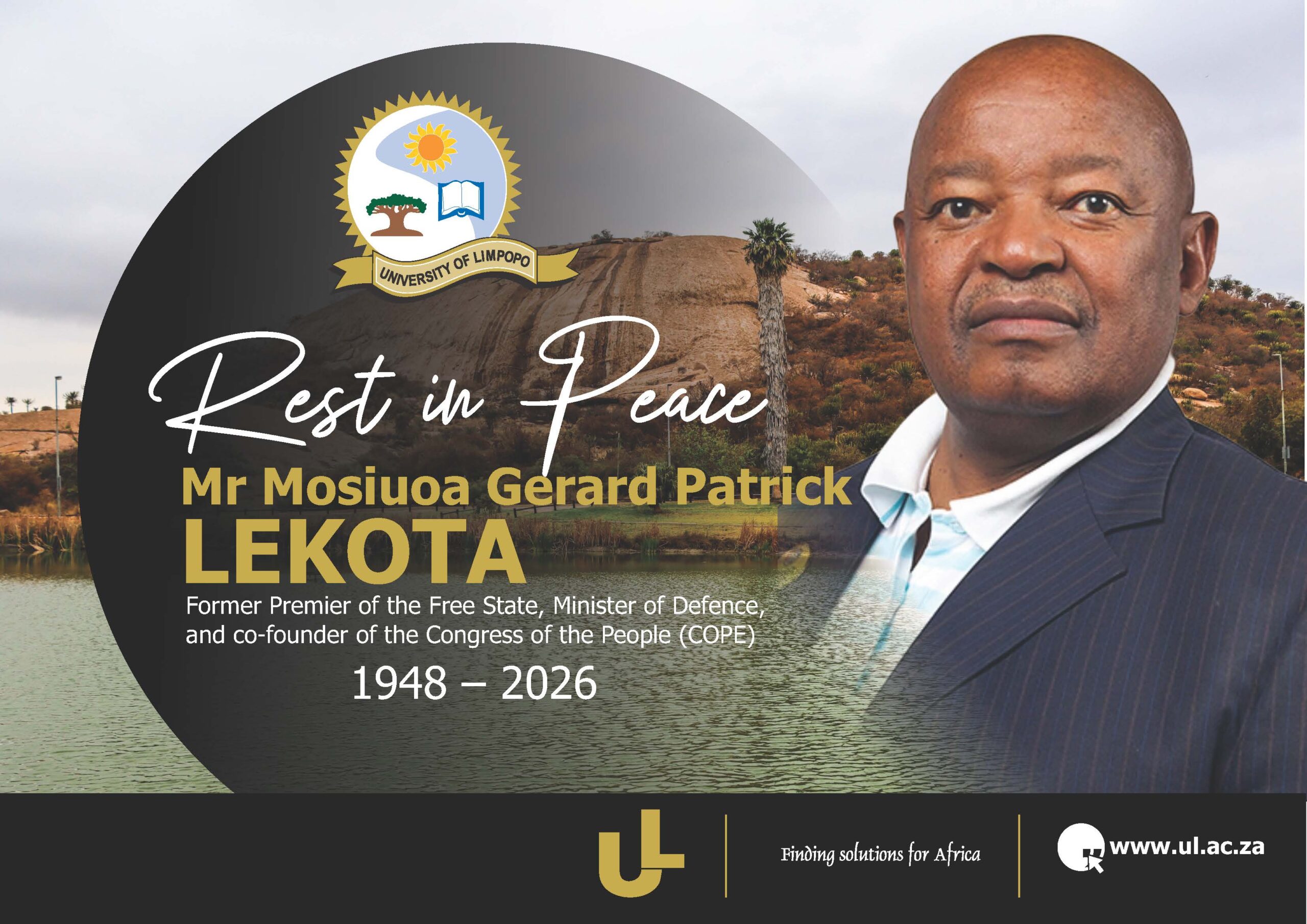
The University of Limpopo (UL) is deeply saddened by the passing of Mr Mosiuoa Lekota, who enrolled for a Bachelor of Social Sciences qualification at the then University of the North (now UL) in 1971.
Mr Lekota, fondly remembered by fellow students at the time as “Terror” – a nickname he earned on the Turfloop sports grounds as a lethal football striker – was a student activist in the anti-apartheid struggle, during which his political consciousness was shaped within the Black Consciousness Movement.
In September 1971, he was elected to the Student Representative Council (SRC) at UL and later served in its executive leadership. The UL Council Chairperson, Mr Pandelani Nefolovhodwe, who served with him in the SRC, recalls him as part of an influential SRC leadership collective that changed the tide of political consciousness and activism at Turfloop. “That SRC championed the process of encouraging Black staff members to organise themselves into a structure called the Black Academic Staff Association (BASA) – a direct response to the increasing political repression and racial polarisation on campus. As the SRC, we also requested Onkgopotse Abram Tiro, the past SRC president at the time, to deliver a speech at the 1972 graduation ceremony. We asked the executive, of which Mr Lekota was a member, to work with Tiro in preparing the address,” Mr Nefolovhodwe says.
The address later became known as the Turfloop Testimony, a historic speech that openly challenged apartheid education and institutional authority, and which ultimately led to Tiro’s expulsion from the university. In response, Mr Lekota was among the SRC leaders who mobilised students to protest against the expulsion. The protest action resulted in the university authorities suspending the entire SRC in 1972 for a period of one year. Following the suspension, Mr Lekota and other SRC members became actively involved in the South African Students’ Organisation (SASO) General Council. “We started mobilising for universities across the country to close their doors in protest,” Mr Nefolovhodwe explains. Despite the restrictions placed on SASO activities on campus, Mr Lekota remained actively involved in the organisation. While some of the suspended students reapplied for admission after their suspension period, he chose instead to continue his political activism outside the university.
In July 1974, Mr Lekota was elected to the SASO executive as a permanent organiser, a position previously held by Tiro before he fled the country in 1973. At the time, Mr Nefolovhodwe served as SASO President. “At one of our meetings in Durban, we resolved to organise rallies to celebrate the independence of Mozambique. The celebrations began in Durban, where the SASO headquarters were based, and Mr Lekota worked from there,” he recalls.
Mr Lekota, together with the then SASO General Secretary (Muntu Myeza), played a leading role in organising the Viva FRELIMO Rally, which celebrated the independence of Mozambique from Portuguese colonial rule. As a result of these activities, he was arrested along with eight other SASO members, including Mr Nefolovhodwe. He was charged under the Terrorism Act, convicted, and sentenced to six years’ imprisonment on Robben Island. Mr Lekota is remembered by many for his distinguished contribution to public service in democratic South Africa. Among many other roles in various organisations, he served as the first Premier of the Free State Province from 1994 to 1996, later as Chairperson of the National Council of Provinces, and subsequently as Minister of Defence of the Republic of South Africa. He later co-founded and led the Congress of the People (COPE), which was launched in December 2008.
The University community is deeply saddened by his passing. The University’s Council and Executive Management extend their sincere condolences to the Lekota family, his comrades in the struggle, and all those whose lives he touched through his lifelong commitment to justice, democracy, and public service.
End.
Issued by: Marketing and Communication, University of Limpopo
For Enquiries: Victor Kgomoeswana
082 495 0093 l victor.kgomoeswana@ul.ac.za